
Six Places a Mixed-Age, Mixed-Fitness Group Tends to Struggle in Asakusa and How to Avoid Them, Plus How to Fit Street Kart into the Same Trip
Six Places a Mixed-Age, Mixed-Fitness Group Tends to Struggle in Asakusa and How to Avoid Them, Plus How to Fit Street Kart into the Same Trip
You're standing right under the huge red lantern at Kaminarimon with your phone raised. You frame the shot and press the shutter. When you turn around, the person who was next to you a moment ago is gone. You look around and find them a few meters ahead at the entrance to Nakamise, stuck in the crowd and unable to move.
In Asakusa, this happens all the time.
The old downtown streets are full of charm, and they look great in photos. But if your group doesn't share the same walking pace or stamina, what should be a fun day can turn into a loop of "hang on a second" and "where are you now?" This article goes through the places in Asakusa where groups most often run into trouble, one at a time, and explains how to avoid each so that everyone can enjoy the day at a comfortable pace. The second half also covers how to fit Street Kart, which you can ride in Tokyo, into the same trip.
Why It's Harder Than You'd Expect for Everyone to Enjoy Asakusa Together
Asakusa's main sights sit almost in a straight line, from Kaminarimon through Nakamise-dori to the main hall of Sensoji Temple. On a map, you couldn't possibly get lost. That's exactly why people let their guard down.
The real challenge isn't distance. It's the crowds. Nakamise is an approach to the temple lined on both sides with small shops packed close together, and the flow of people rarely lets up. Some people stop to take photos, lines form at the snack shops, and more people keep coming from the other direction. For someone full of energy, it's nothing. For someone unsure of their legs, or someone who doesn't handle crowds well, it becomes a long walk with nowhere to sit down.
If I were explaining it to someone from Taiwan, I might say it feels like the bustle around Longshan Temple with the crush of a night market added on top. But if you bring your night-market habits along unchanged, some things will trip you up. It feels similar, yet something is different. Travelers from elsewhere in Asia usually get caught out by exactly these small differences.
One thing to know up front: how crowded Asakusa gets varies a lot by day of the week, by season, and by events such as festivals. Nobody can promise that a certain time will be quiet. So instead of trying to catch a quiet window, it's more reliable to plan a day that still works when it's crowded.
Mistake 1: The Group Scatters in Front of Kaminarimon
Kaminarimon is the face of Asakusa. Everyone wants a photo in front of the lantern, so there's always a crowd at the gate. While people are busy taking pictures, the group drifts apart. That's the first thing likely to go wrong here.
The fix is simple: before you arrive, agree on where to meet if anyone gets separated. The spot directly in front of Kaminarimon is too crowded to work as a meeting point, though. Choose a place a little away from the gate where people can stand still without blocking the flow, and look it up on a map app together so everyone knows where it is. If someone in the group doesn't have a smartphone, writing it on a piece of paper for them isn't a bad idea.
A photo tip while you're there: shoot the lantern from directly below, looking up, and the crowd around you is less likely to end up in the frame. There's a dragon carving on the bottom of the lantern, and the upward angle brings out the vermilion color and the texture of the wood. The shot turns out better than you might expect. Whoever is taking photos should step to the side of the gate and avoid stopping in the middle of the flow. That alone keeps you from bumping into anyone.
Mistake 2: Trying to Walk All of Nakamise-dori in One Go
Once you step into Nakamise, the sweet smell of freshly baked ningyo-yaki mixes with the savory, oily aroma of fried manju. You'll see travelers in kimono, shopfronts full of folding fans and tenugui towels, and decorations running overhead. While you're looking around, your feet just keep carrying you forward.
A common mistake here is trying to walk all the way to the main hall without a break. The fitter members lead from the front, and the slower walkers push themselves at the back. By the time you reach the main hall, one person is completely worn out.
What works is putting the slowest walker at the front. Everyone behind just follows their pace, so the group naturally moves at the same speed. If you split up the jobs, with one person carrying bags and another reading the map, the slower walker can simply enjoy the scenery.
There are also streets running parallel to Nakamise on both sides, and they're sometimes less crowded than the middle of the main approach. Enjoy the bustle of Nakamise on the way in, then take a side street on the way back. That simple split cuts down the time you spend in the crowd by quite a bit.
Mistake 3: Eating While Walking Like You Would at a Night Market
At a Taiwanese night market, eating while you walk is completely normal. At Nakamise in Asakusa, though, the widely promoted etiquette is to finish your food in front of the shop where you bought it before you move on. You may even see signs saying so at some shops.
Eating on the move along a crowded approach can mean getting food on someone's clothes or bumping into an older member of your group. When you want to buy a snack, first check whether there's room to stand in front of the shop. If there isn't, don't force it. That level of judgment is about right.
If someone is tired from walking, it's easier on everyone to go into a sweets shop or café and eat sitting down. Taking your time over anmitsu or matcha sweets is a good break in itself. As you'd say in Chinese, "好吃又可愛" (delicious and cute). Many of the sweets look as cute as they taste, so the photographers in your group won't be left with nothing to do.
Mistake 4: Wandering Around Sensoji's Grounds Looking for Somewhere to Rest
The grounds in front of the main hall are open and pleasant. On the other hand, there isn't much shade. In summer, the heat reflecting off the stone paving is intense, and in winter the wind cuts through and chills you. The same place can feel completely different depending on the season, so "it was fine last time" isn't something to rely on.
In front of the main hall is a large incense burner, and you'll often see people fanning the rising smoke toward themselves with their hands. At Taiwanese temples it's common to pray while holding incense sticks, so visitors from elsewhere in Asia may be a little surprised to see it done this way. Anyone who doesn't like smoke can simply wait a short distance away.
The mistake here is looking for a place to rest only after you arrive. While you're searching, the tired person's energy keeps draining. Before you enter Nakamise, pick a few places where you can sit down. If the place you planned on isn't available, cut the sightseeing short and take a break first. Getting drinks before you enter Nakamise also saves you from scrambling once you're on the temple grounds.
On rainy days, the wet stone paving gets slippery, and umbrellas easily collide in the crowd. For anyone unsteady on their feet, rainwear that keeps both hands free can make walking feel more secure.
Mistake 5: Going On to the Sumida River and Running Out of Energy on the Way Back
A short walk from Sensoji brings you to the Sumida River. From the riverside you can see Tokyo Skytree, so the low houses of the old town and the tower rising straight into the sky fit into a single view. Framing the river and Skytree together from Azumabashi Bridge is a shot that never gets old. In the evening, the changing colors of the sky look different in every season.
There's a catch, though. On the way there, you're so taken with the scenery that you don't notice the distance, but it hits hard on the way back. After a lot of walking around Sensoji, a round trip to the river can easily leave one person at their limit by the end.
The fix is to decide before you set off how far you'll go before turning back. It's a perfectly good choice for only the members with energy to spare to go to the river while everyone else waits at a café. Not everyone has to go everywhere. The person who photographed the river shows the pictures to the ones who waited at the café and says, "Let's come here together next time." Moments like that become real memories of the trip too.
Mistake 6: Packing Too Much into the Schedule After Asakusa
Walk around Asakusa, then head straight off shopping, then on to another neighborhood. That might be fine for the most energetic people, but a group with a wide range of ages and fitness levels will still be tired the next day.
Asakusa takes more energy than its size on a map suggests. You walk through crowds, you keep stopping, you go up and down steps. Each thing is small on its own, but they add up. Keep the schedule light on your Asakusa day and save other activities for another day. In the end, that lets everyone enjoy the trip for longer.
Things to Keep in Mind When Putting Asakusa and Street Kart in the Same Trip
Some of you may want to try Street Kart while you're in Tokyo. First, here's how the tours work.
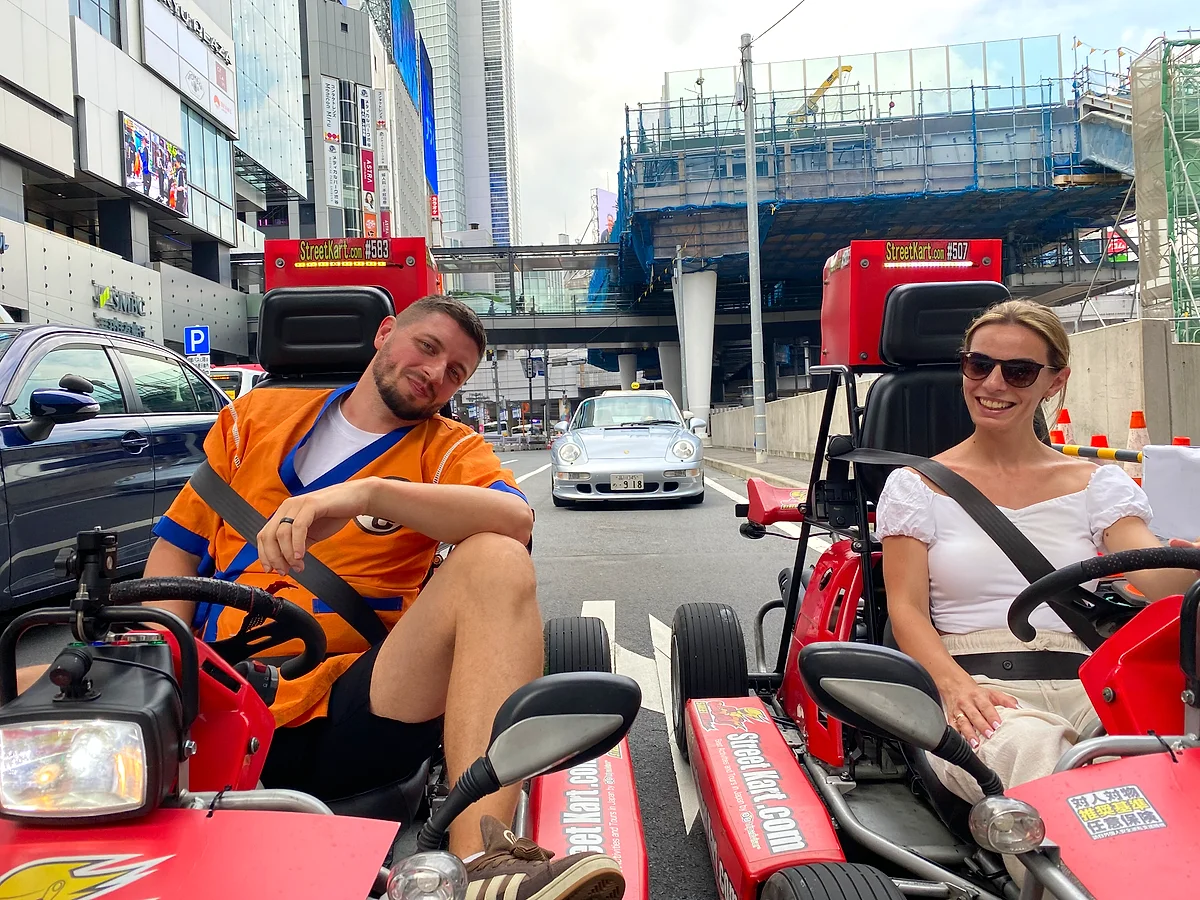
Street Kart is a tour where you drive a set route for each shop, led by a guide. Check the route for the shop you want on the official website (kart.st). Planning gets easier if you think of it this way: Asakusa is a place to enjoy on foot, and the karts are something you ride at a different time in a different part of the city.
There are seven shops in Tokyo. Akihabara has two. Shibuya also has two, Shibuya and Shibuya Annex, and each pair is at nearly the same location. Other shops include Shinagawa and the Tokyo Bay shop in Shinkiba. The Akihabara route highlights include the red-brick Marunouchi building of Tokyo Station, Ginza, and the Akihabara Electric Town, and the Shibuya route highlights include Shibuya Scramble Crossing and Omotesando. On a trip where you took in the old townscape of Asakusa, you could spend another day driving past the red-brick station building and along the streets of Ginza. It's the same Tokyo with a different face. Check the official website for route details.
That said, there are a few things that often trip people up.
First, don't plan on the assumption that everyone can ride. Karts are single-seaters, so no one can share a kart. Check the age requirements and the driver's license and document requirements on the official website ahead of time. If you confirm before the trip that every member meets them, you can go into the day without worrying.
Second, don't schedule karting on a day when you've already done a lot of walking in Asakusa. You don't want to drive when you're tired. Set aside time on karting day just for that.
Take public transportation to the shop. The shops have no parking.
Weekends tend to book up, so it's a good idea to reserve early once your dates are set. Reservations are accepted via Facebook, LINE, and email. See the official website for details.
You should also know about language. Guidance on the tour day is basically in English. Guidance in Chinese or Japanese depends on the staff working that day and isn't guaranteed. If this matters to you, check the official website in advance.
Decide ahead of time how the members who won't ride will spend their time, too. From the Akihabara shops, Ueno Park is about five minutes away by train, with Ueno Zoo and the Tokyo National Museum. From the Shibuya shop, the forest of Meiji Jingu is about a 20-minute walk. The riders and the people waiting each spend the time their own way, then meet up afterward to swap stories. Planned this way, nobody has to just put up with things.
A word about photos, too. Using your phone while driving is dangerous, so don't. Take pictures before or after the tour, or while the kart is stopped.
What Makes Street Kart Appealing
First, a trained guide drives at the front. Even on Tokyo roads you've never driven before, you don't have to figure out the way as you go. Just follow the guide ahead of you and you'll stay on the set route.
Each shop has its own route, with sights all along the way. From Akihabara, the red-brick station building and the streets of Ginza. From Shibuya, the Scramble Crossing where waves of people cross. The Tokyo Bay shop's route includes the Rainbow Bridge, which is lit up in seven colors at night. Choosing a shop means choosing which side of Tokyo you want to see. Seen that way, even the choosing becomes part of the fun.
The feeling of the ride is unique as well. The wind hits your face directly, and you hear the crossing signals and the buzz of the city right beside you. A city you thought you knew feels a little closer.
Here are some numbers, too. As of November 2023, across all shops combined, there had been more than 150,000 tours and more than 1.34 million customers. There were more than 20,000 reviews, with an average rating of 4.9 out of 5.
The website is available in 22 languages. That applies to the website only and is separate from the language used for guidance on the day.
There are nine shops nationwide: seven in Tokyo and one each in Osaka and Okinawa.
Three Things the Whole Group Should Talk About Before Setting Out
Finally, here are three things worth talking over as a group before you leave, so your Asakusa day doesn't fall apart.
First, where to meet if anyone gets separated. Not directly in front of Kaminarimon, but somewhere a little away from it where people can stand calmly.
Second, when to rest and when to turn back. "Tell us if you get tired" doesn't work as well as you'd think, because some people hold back and don't say anything. It goes better if you decide in advance, for example: "We'll sit down once we get through Nakamise," or "Only the people who want to go will walk to the river."
Third, agree that not everyone has to do the same thing. There can be a day when you walk only part of Asakusa together, and a day when you split up, with some people riding karts and others spending time in Ueno or at Meiji Jingu. A trip where each person moves at a pace that suits their energy leaves stronger memories when you look back on it later.
The red of Kaminarimon, the sweet smells along the approach, the main hall beyond the incense smoke, Skytree seen across the river. You'll remember the old-town scenery much longer if you take it in at everyone's pace instead of rushing through.
If you're adding Street Kart to your trip, start by checking the requirements for everyone planning to ride, and the dates you want, on the official website. If you're thinking about a weekend, book a little early. Tour details and reservation information are all on the Street Kart official website.
This article was originally written in Japanese and translated using AI. Some expressions may read unnaturally, and we appreciate your understanding. For the most accurate and up-to-date information, please refer to the official site at kart.st.
Street Kart is not affiliated with Nintendo or the Mario Kart series in any way. We do not provide costumes of Nintendo characters, and such costumes may not be worn during tours even if brought by participants.